The Consolation of Medieval Philosophy
Boethius talks to a goddess at the end of the Roman Empire

If you follow me on Notes, you may have heard that I’m taking a medieval British literature class at my local community college this fall.
One of the key texts we’ve been reading in The Consolation of Philosophy, by the Roman statesman and polymath Boethius. Boethius was born shortly after the forced abdication of the last western Roman emperor. He served under Theodoric the Great, the Ostrogoth king of Italy, at a time when the Senate and other Roman state apparatus were still clunking along under the new regime.
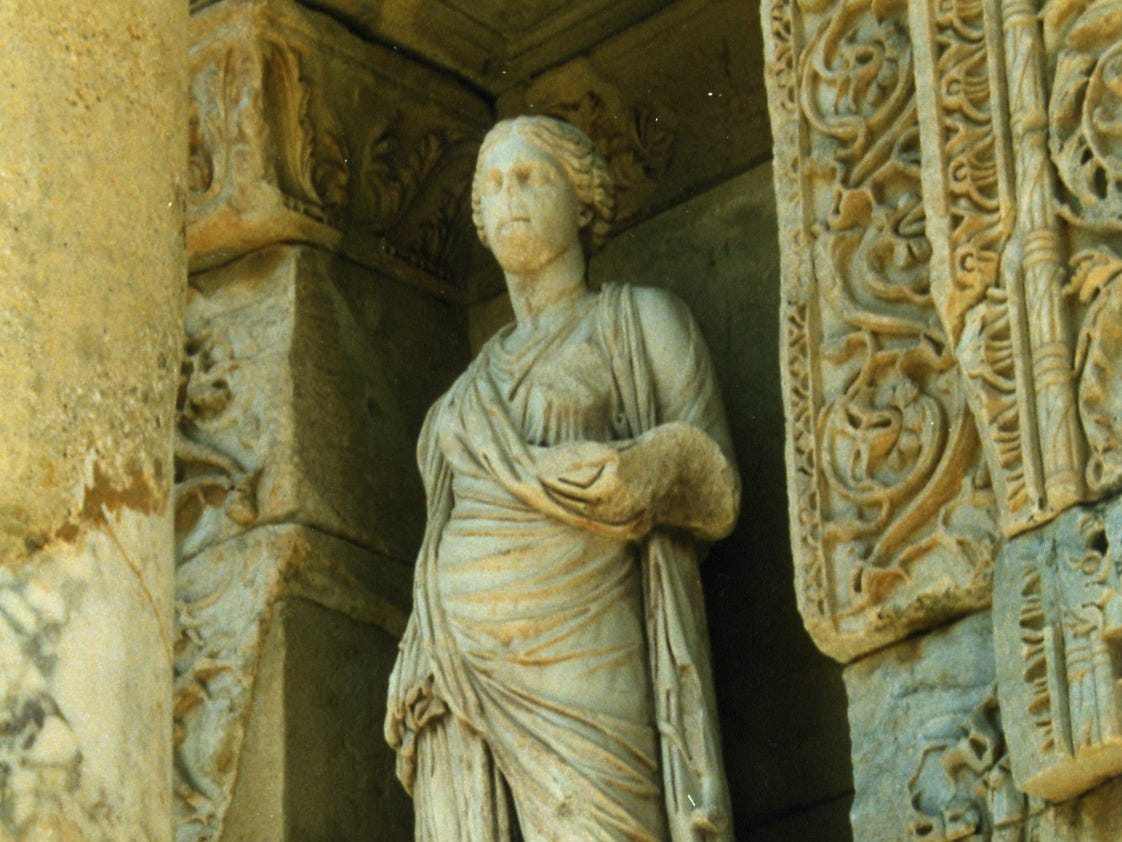
Although Boethius had a flourishing career and was apparently in favor with the king at one point, he ended up on the wrong side of politics, and was accused of treason, banished, and finally executed. During the period of time when Boethius was waiting to die (524 CE), he wrote a short book in the form of a dialogue with Philosophy, here represented as a beautiful woman who is somewhere in between allegorical figure, Pagan goddess, and Christian Mary-Sophia figure:
The dialogical form of the book is important, something like a Socratic dialogue and also a therapy session, aimed at helping Boethius find peace with his changed circumstances. It’s also not far off from certain Buddhist sutras, especially ones like the Heart Sutra where the primary speaker is a non-physical spiritual entity.
I’m sure the traditional interpretation of the Consolatio is that Boethius uses Philosophy as an allegorical figure in order to express his views, which attempt to reconcile the Neoplatonist worldview of late antiquity with the new religion of Christianity. But as a depth psychologist and animist, I believe there’s more to it.
Imaginal dialogues (which I discussed in my recent Human Intelligence Manifesto) are at the heart of the mystical traditions, both East and West. Is Boethius’ conversation with Philosophy all that different from Carl Jung’s dialogues with his inner figures, which formed the core of his psychology and are recorded in the Red Book? From a Jungian perspective, we could see Boethius’ dialogue as a form of active imagination, engaging in conversation with Philosophy as an archetypal figure.
But these kinds of dialogues also predate Jung by millennia, even in the West, where the shamanic journeys of the iatromantes (healer-seers) helped establish the roots of Greek philosophy. And in non-Western cultures, conversations with spiritual beings are an accepted part of life and recognized source of spiritual wisdom. Could Boethius’ conversation with Philosophy have been more mystical and less purely rhetorical than we usually take it for?
The existence of non-physical beings was an established part of the medieval worldview. C.S. Lewis, in his excellent short book The Discarded Image, notes that the medievals inherited from the ancient world a universe that was alive with spiritual beings of all kinds, including the aerial and aetherial spirits who inhabited the regions in between the Earth and the higher heavens. This represents a survival, well into the Christian era, of an animist worldview.
As for Boethius, I believe his Consolation has some useful medicine to offer for our times. Then as now, most of us are entirely preoccupied with materialistic concerns: the acquisition of money, stuff, status, and fame (or followers, anyway). Boethius rightly concludes that none of these offer lasting happiness, and turns instead to the pursuit of the highest happiness and the highest Good, which he identifies with God.
While I don’t agree with all of Boethius’s arguments, I can see why people throughout the Middle Ages found such value in this text. As a kind of summary of ancient philosophy and a reconciliation of Neoplatonism with Christianity, I see it as a key text not only in the Western spiritual tradition, but in the wider Perennial Tradition. There are even echoes between Boethius and Buddhist philosophy or the Vedanta of the Upanishads, as when Philosophy says:
If any man makes search for truth with all his penetration, and would be led astray by no deceiving paths, let him turn upon himself the light of an inward gaze, let him bend by force the long-drawn wanderings of his thoughts into one circle; let him tell surely to his soul, that he has, thrust away within the treasures of his mind, all that he labours to acquire without.
I’m also finding parallels with the teachings of Freemasonry, and would guess Boethius was an important source for early Masons.
If you haven’t yet read The Consolation of Philsophy, I highly recommend doing so. I slept on this one for ages, and it took a community college class to get me to finally pick it up. Also, thanks to the several friends who recommended The Discarded Image to me over the years; it’s quickly becoming one of my favorite books.
That’s all for this week! As always, I appreciate your feedback on Mind, Meaning, and Magic. Have you read The Consolation of Philosophy? If so, what did you think? Have you read any other texts in the form imaginal dialogues, like Carl Jung’s Red Book? Let me know in the comments.
Thanks for reading,
Chris Cordry, LMFT
This post was written without the use of AI.
I'm lifted up by the fact of your study and that you are taking the time and choosing to place your attention these texts and teachings Chris. I would "like to" but can't imagine finding the time to engage in this kind of study and keep up with everything else. I feel a little alarmed by that fact. But then wonder if it's just a matter of choices and priorities. A new business to run, exercise and self-care, traveling for speaking presentations, family commitments re a marriage and a kid, I am sprinting from moment to moment to keep up. How did you prioritize this? Not sure if my dilemma is making any sense, but maybe you have some insight to offer?